 "Index/Dos'e na Tsenzuru" Home page | Issue 31 Russian version
"Index/Dos'e na Tsenzuru" Home page | Issue 31 Russian version
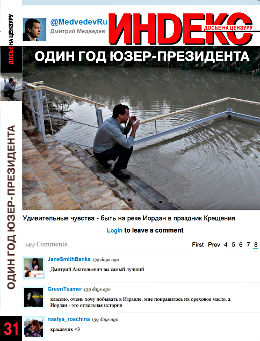 The new issue entitled “A YEAR WITH A TWITTERING PRESIDENT” sums up some results of 2010. The section “VOCAL SOLO” reviews last year’s major events by way of reprinting the full collection of Dmitry Bykov’s weekly pamphlet poems from Novaya Gazeta. The main section features reflections on social and personal security (a sociological essay by Boris Dubin); on trampling down the law under the disguise of justice administration (articles by L. Golovko and G. Pasko); on secret services’ degradation (a story by A. Soldatov and I. Borogan), and other materials. In the “HISTORY” section, you will find a detailed and very interesting narrative “The Yudin Case” by V. Topolyansky, and S. Grigoryants’ memoirs about the Chistopol prison at the dawn of perestroika.
The first section, “VOCAL SOLO”, opens with the full collection of D. Bykov’s weekly pamphlet poems (reprinted from the newspaper Novaya Gazeta), giving an insight into Russia’s life in 2010.
The main section features B. Dubin’s sociological essay “Majority and Minority” analysing citizens’ attitudes to various aspects of social security, and a chapter from the same author’s new book about Russia in the 2000s. In the story “Profaning the Law”, L. Golovko expresses concerns that the establishment of a law-ruled state system seems ever less likely in Russia. G. Pasko’s article “Doomed to Eternal Trial, They Can Only Dream of Freedom…” points to the harmful effect the Khodorkovky case has had on Russia’s justice system – a topic further discussed in a reprinted chapter from S. Kovalyov’s new book about the Khodorkovsky trial. A. Soldatov and I. Borogan’s analytical article “Special Service Performance in 2010” highlights problems facing the Russian secret services and suggests these may be affected by degradation processes. In his story “Registered as Persons Prone to Extremism” (about the Kutuzov case), Alex D. Epstein observes that the Law on Combating Extremism has been pushing Russia ever more off the road of compliance with the principles of justice; and that application of this law has ever more often turned into an instrument of suppressing dissent. The same point is stressed in a reprinted excerpt from the SOVA think tank’s report “Unlawful Application of Anti-Extremist Legislation in Russia in 2010”. That is followed by G. Lukashin’s article “Effects of Non-Professionalism” pointing to threats to Russia’s nuclear safety about which experts and responsible government officials have kept silent. In his article “One May Err but Must Not Lie”, A. Simonov reflects on present-day journalism. The section closes with G. Ramazashvili’s article “Barbarisation 2010”, which assesses the state of civil society in today’s Russia as deplorable.
The “HISTORY” section features a detailed and very interesting documentary study “The Yudin Case” by V. Topolyansky, and S. Grigoryants’ memoirs “Penitentiary Restructuring: First Prisoners of Conscience Released” about the Chistopol prison during the early years of perestroika.